~90% smaller models · ~3.5× faster inference
Edge environmental & fire intelligence — ML optimization and Earth‑observation validation
Partnered with a deep-tech team to optimize an edge AI environmental intelligence stack, combining model compression, sensor stabilization, and satellite validation for field-ready reliability.
Model compression
~90%
Inference speedup
~3.5×
Quantization
INT8 / INT4
EO products
VIIRS + GOES‑16
I partnered with a deep‑tech hardware team shipping a proprietary badge‑class edge device (client name withheld for confidentiality) aimed at continuous environmental sensing and high‑stakes fire‑risk awareness in the field. The mandate was blunt: make on‑device deep learning fast, small, and trustworthy enough for real‑time use, while chemical sensors drifted with weather and manufacturing spread introduced inconsistent baselines. Success meant fewer false alarms, lower latency, and a narrative procurement and safety leads could defend.
The operating pressures mapped cleanly to what technical program managers and engineering leads interview for: tight on‑chip budgets, accuracy loss when temperature and humidity swing, device‑to‑device variance after calibration, the need for high‑confidence fire detection that did not rely on a single modality, and inference paths bloated by redundant or low‑value inputs. My bias was to treat this as an end‑to‑end system problem — model, signal chain, and geospatial validation — not a single‑file accuracy bake‑off.
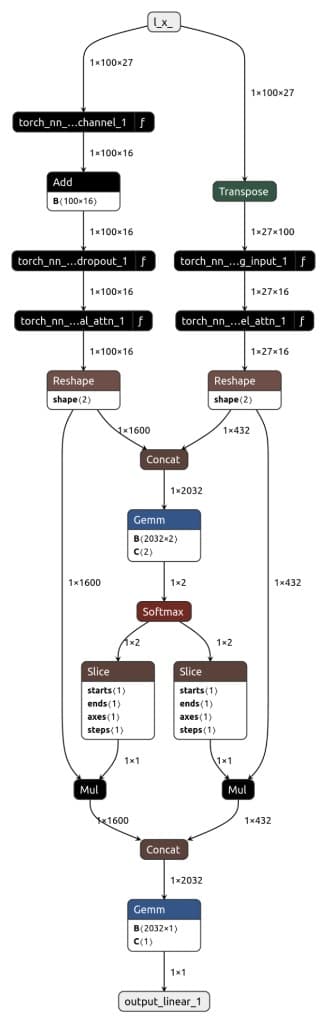
On the model side I drove an optimization pipeline in PyTorch: structured pruning and INT8 / INT4 quantization to hit memory and latency envelopes without giving away the behaviors that mattered in production. We paired that with gradient‑based feature attribution to rank sensor channels, then removed low‑impact inputs so runtime and acquisition cost dropped without measurable backslide on the validation suites the client cared about.
Sensor reality needed its own chapter. I specified recursive exponential moving averages to track long‑horizon temperature and humidity trends so short‑term chemistry did not read as catastrophe, and first‑order temporal derivatives to strip absolute baseline offsets introduced in manufacturing — so devices disagreed less on “what zero means” while still preserving the dynamics that drive detection. Together, that is the kind of cross‑disciplinary thread that sits between ML, DSP, and hardware program management.
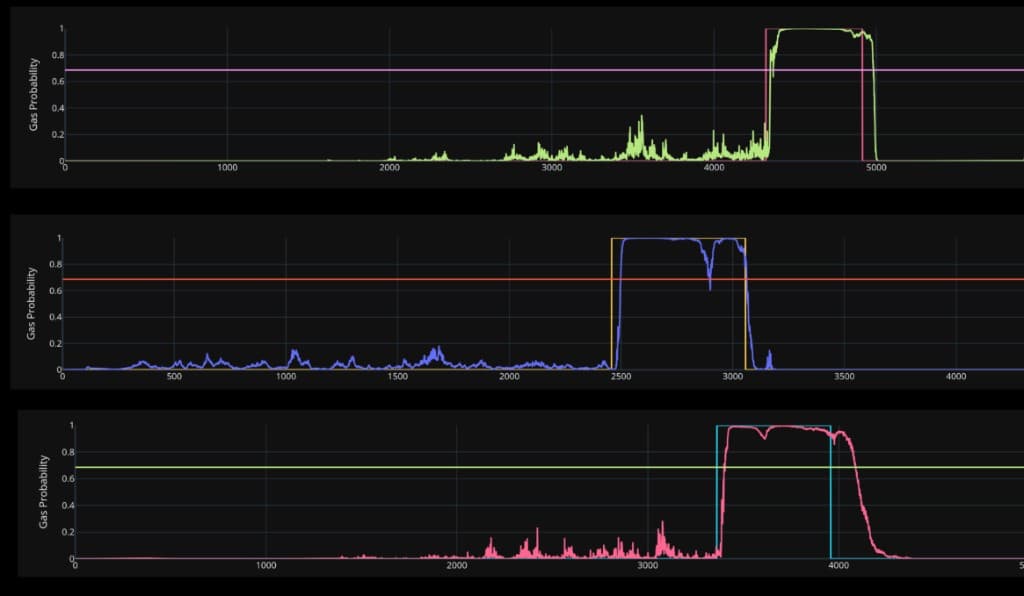
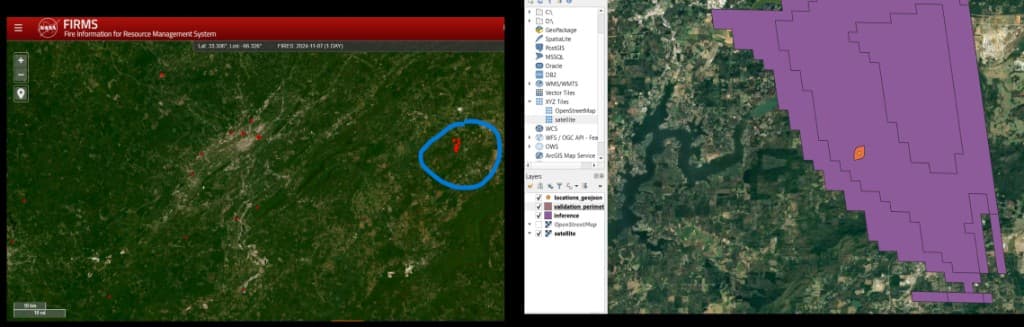
For satellite‑based fire event validation I stood up ingestion and alignment around NASA FIRMS (VIIRS 375 m thermal anomalies) and GOES‑16 ABI fire products, then wired GIS workflows so on‑ground inference could be read against authoritative footprints — the composite in the gallery is representative of that discipline, not a public client drop. The goal was defensible multi‑source Earth observation context executives could trust when field alerts spike.
The headline metrics we anchored exec reviews on are simple for recruiters to scan: roughly ninety percent smaller models, about three and a half times faster inference, a materially smaller memory footprint after quantization, calmer cross‑device behavior despite manufacturing spread, and lower runtime and data overhead after importance‑weighted input reduction. If you are hiring a technical lead or PM who can span edge ML delivery, sensor‑heavy products, and geospatial validation, this is the shape of the work.
Model and validation depth
The optimization architecture we targeted on-device, and how field inference was cross-checked against NASA FIRMS and GOES-16 footprints in QGIS — technical artifacts from the engagement, not shipping UI.
Outcomes
Delivered major model efficiency gains and more stable field behavior, with a defensible multi-source validation workflow for safety- and climate-critical operations.